

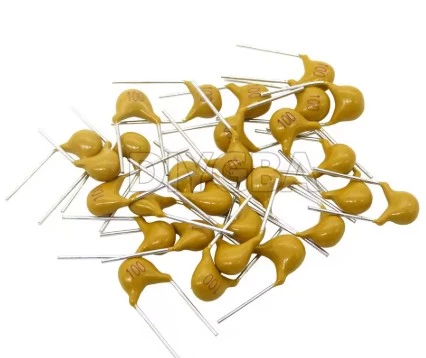
100nf(0.1uf) 50V Monolithic Ceramic Capacitor
Share :
The 100nF (0.1uF) Monolithic Ceramic Capacitor rated at 50V is perhaps the single most common capacitor value found in digital electronics.
Here is a breakdown of its characteristics and why it is so widely used:
Capacitance:100nF (nanofarads) or 0.1uF (microfarads).
Note: It is often marked with the code "104" (which means 10 followed by 4 zeros, giving 100,000pF, or 100nF).
Voltage Rating:50V.
This is the maximum DC voltage that can be safely applied. Since most digital logic (microcontrollers, ICs) runs at 3.3V or 5V, 50V provides a generous safety margin.
Type:Monolithic Ceramic Capacitor (MLCC).
This means it is constructed from multiple layers of ceramic dielectric and metal electrodes, giving it a high capacitance value in a small, compact size.
Polarity:Non-polarized.
It can be connected in any direction in a circuit.
Dielectric Material: Typically, a Class 2 ceramic material like X7R or Z5U, which offers high volumetric efficiency.
The primary and most critical use of the 100nF ceramic capacitor is for decoupling or bypassing the power supply lines for Integrated Circuits (ICs) and microcontrollers.
Why Decoupling is Necessary:
When a digital IC or microcontroller performs a task (like switching logic states), it draws a sudden, brief surge of current.
Noise: These sudden current demands create voltage spikes and noise on the power lines (VCC, GND).
Impedance: The power supply wires and PCB traces have a small but significant inductance, which resists these sudden current changes.
Local Reservoir: The 100nF capacitor is placed as close as possible to the IC's VCC and GND pins. It acts as a tiny, local energy reservoir that can supply the sudden current surge immediately, effectively "decoupling" the high frequency switching noise from the main power rail and stabilizing the voltage right at the chip.
Due to its stability, low cost, and good high-frequency characteristics, the 100nF ceramic capacitor is also widely used for:
Noise Filtering: Filtering out unwanted high-frequency noise and ripple in power supplies and analog signals.
Signal Bypassing: Shunting high-frequency AC signals to ground to prevent them from interfering with sensitive parts of the circuit (especially in RF circuits).
Timing Circuits: Used in conjunction with resistors in RC filter networks and non-critical timing circuits (like basic oscillators or pulse generators).
Signal Coupling: In some low-frequency audio or signal processing stages, it is used to couple (pass) AC signals from one stage to the next while blocking the DC voltage bias.