

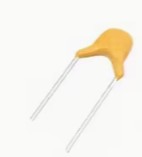
100PF MONOLITHIC CAPACITOR
Share :
The Monolithic Ceramic Capacitor (MLCC) is the most ubiquitous and heavily produced capacitor type in electronics, known for its small size, high capacitance density, and non-polarized nature. When described as "50V" and "Yellow," it typically refers to a low-voltage, general-purpose MLCC with radial leads.
Construction (Monolithic): MLCCs are constructed by stacking alternating layers of ceramic dielectric material and metal electrodes (hence "Multi-Layer"). This process allows for extremely high capacitance values in a very small volume.
Voltage Rating (50V): This low working voltage rating (e.g., 50V, 100V) makes them standard components in low-power digital and analog circuitry, such as decoupling (bypass) and filtering applications in microcontrollers (like the ESP32) and audio circuits.
Dielectric Material & Color (Yellow/Class II): The yellow coating often indicates a Class II ceramic dielectric (e.g., X7R or Z5U). These materials offer high capacitance values but their actual capacitance can vary significantly with temperature and applied DC bias voltage (DC-bias effect).
Physical Form: Unlike the bulky, high-voltage ceramic capacitors, these radial-leaded monolithic capacitors are compact and rectangular. The majority of MLCCs today are surface-mount devices (SMD), but the radial-leaded version remains popular for through-hole prototyping.
Decoupling/Bypass: Placed close to the power pins of ICs (like the ESP32) to shunt high-frequency noise and provide instant local current, stabilizing the power rail.
Filtering: Used in low-pass and band-pass filters in analog signal processing.
Timing: Employed in oscillator and timing circuits due to their predictable behavior and small footprint.