

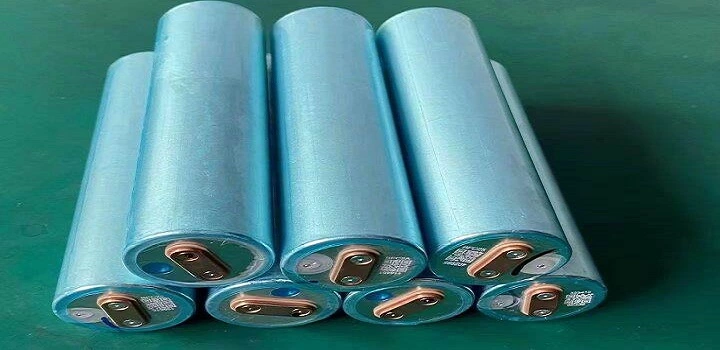
15.5AH/3.2V LIFEPO4 Battery (used)
Share :
The Gotion 15.5Ah / 3.2V LiFePO4 battery is a high-performance Lithium Iron Phosphate (LFP) single cell, manufactured by Gotion High-Tech. This cell is typically designed in a cylindrical format, often referred to by the sizes 32135 or 33140 (approximately 33mm diameter times 140mm long).
It is part of Gotion's offering for applications that require a combination of high power, long cycle life, and excellent safety.
Key Specifications
| Parameter | Value | Details |
| Chemistry | LiFePO4 (LFP) | Lithium Iron Phosphate, known for safety and long life. |
| Nominal Voltage | 3.2V | The average operating voltage of the cell. |
| Nominal Capacity | 15.5Ah | Ampere-hour rating, indicating the charge capacity. |
| Max Charge Voltage | 3.65V | The voltage at which charging is typically terminated. |
| Cut-off Voltage | 2.0V | The minimum safe voltage for discharge. |
| Cycle Life | 2000+ Cycles | Rated cycles at standard conditions (often up to $80\%$ of initial capacity). |
| Standard Charge Current | 0.5C | Approximately 7.75 A (Ah \times C-rate). |
| Max Continuous Discharge | 1C to $5C | Dependent on the specific model variation (e.g., 15.5A up to $77.5A). |
| Form Factor | Cylindrical | Typically in the 33140 or 32135 size range. |
Applications and Benefits
Benefits of LiFePO4 Chemistry
High Safety: LFP batteries are inherently safer than other lithium-ion chemistries (like NMC or NCA) due to their stable iron phosphate cathode structure, which significantly reduces the risk of thermal runaway and fire.
Long Cycle Life: They can handle a greater number of charge/discharge cycles compared to most other chemistries, making them cost-effective over the lifespan of a product.
Stable Voltage: The flat discharge curve means the cell maintains a relatively constant voltage throughout most of its discharge cycle.
Common Applications
Due to its robust design and moderate capacity, this cell is commonly used in applications that require reliability and longevity:
Electric Bicycles and Scooters
Small Energy Storage Systems (ESS)
Portable Power Stations
Golf Carts and Electric Vehicles (EVs) (as part of a larger battery pack)
UPS and Telecommunications Backup Power
This 3.2V cell is the fundamental building block. For higher voltage applications, these cells are connected in series (S), and for higher capacity, they are connected in parallel (P). For example, a $12.8V battery pack would typically use four of these 3.2V cells in series (4S configuration).