

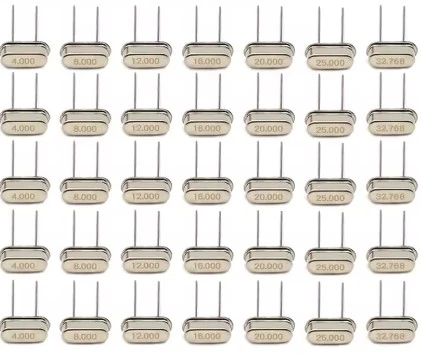
16MHZ CRYSTAL OSCILLATOR
Share :
A crystal oscillator is an electronic circuit that uses a vibrating piezoelectric crystal, typically made of quartz, as its frequency-selective component to generate a highly stable and precise electrical signal (a clock signal).
It is a crucial component in nearly all modern electronic devices that require reliable timing, such as computers, microcontrollers, communication systems, and digital watches.
The operation of a crystal oscillator is based on the piezoelectric effect and the principle of resonance:
Piezoelectric Effect: Quartz exhibits a property where applying mechanical stress generates a voltage, and conversely, applying a voltage causes the crystal to physically deform or vibrate (inverse piezoelectricity).
Resonance: When the crystal is placed in a circuit and an alternating voltage is applied, it vibrates at its natural resonant frequency. This frequency is determined by the crystal's physical dimensions (size, shape, and the angle it is cut).
High Q-Factor: A quartz crystal acts electrically like a highly selective RLC circuit, but with a vastly higher Q factor (quality factor) than circuits made with discrete capacitors and inductors. This high Q factor means the crystal has very low energy loss and provides exceptional frequency stability.
- Sustained Oscillation: The crystal is connected in a positive feedback loop with an amplifier (usually a transistor or inverter). The amplifier boosts the small electrical signal generated by the crystal's vibration, and this amplified signal is fed back to the crystal, reinforcing its natural resonance and sustaining the oscillation at a precise, consistent frequency.
💡 Types of Crystal Oscillators
While the simplest type is the Simple Packaged Crystal Oscillator (SPXO), more specialized types are used to achieve extreme accuracy and stability under varying environmental conditions:
| Type | Full Name | Stabilization Method | Primary Application |
| XO (SPXO) | Crystal Oscillator (Simple) | None (inherent crystal stability) | Microcontrollers, basic consumer electronics. |
| VCXO | Voltage-Controlled XO | Output frequency is finely adjustable by an external voltage input. | Phase-Locked Loops (PLLs), frequency modulation. |
| TCXO | Temperature-Compensated XO | Uses a temperature sensor (thermistor) and compensation circuitry to correct for frequency drift caused by temperature changes. | GPS receivers, mobile communication devices. |
| OCXO | Oven-Controlled XO | Houses the crystal and oscillating components inside a miniature temperature-controlled oven to maintain a constant, stable temperature. | Telecommunications base stations, high-precision test equipment. |
The high stability and accuracy of crystal oscillators make them indispensable for:
Clock Signals: Providing the basic clock reference signal for CPUs, microprocessors, and microcontrollers (e.g., 32.768kHz for Real-Time Clocks, 16 MHz or higher for processor speed).
Radio and Communication: Stabilizing frequencies in radio transmitters and receivers, Wi-Fi, and Bluetooth modules.
Timing: Ensuring accuracy in digital watches, clocks, and timers.
Data Transfer: Synchronizing data transmission in high-speed interfaces like PCIe and Ethernet.