

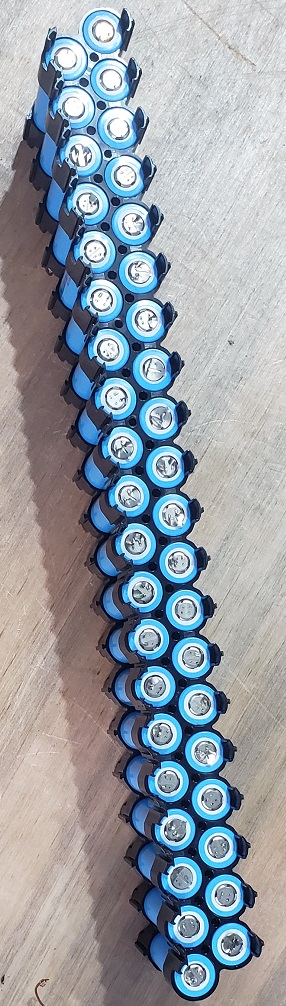


2.5AH LITHIUM ION 3.7V X 40 CELLS WITH FREE BRACKET
Share :
EVE Energy is a major manufacturer of power sources, and their 2.5 Amp-hour (Ah) Lithium-Ion cells are commonly used as building blocks for high-performance battery packs in various portable electronics, electric vehicles (EVs), and energy storage systems (ESS).
Capacity (2.5 Ah): This nominal capacity means the cell can theoretically deliver a continuous current of 2.5 Amps for one hour before its voltage drops below the cutoff threshold, or, for instance, 5.0 Amps for 30 minutes. This value represents moderate energy storage suitable for high-density applications.
Chemistry (Lithium-Ion): These are typically Lithium Nickel Manganese Cobalt Oxide (NMC) or Lithium Nickel Cobalt Aluminum Oxide (NCA) cells. Both chemistries offer high energy density and high discharge rate capability, making them highly versatile.
Nominal Voltage: The standard nominal voltage for Li-Ion cells is 3.6V or 3.7V, with a typical charging cycle ranging from 3.0V (discharge cutoff) to 4.2V (fully charged).
Form Factor: EVE cells are often produced in the cylindrical 18650 format (18mm diameter, 65mm length), which is the industry standard for combining cells into robust packs.
High Discharge Rate: These cells are engineered to safely deliver high burst currents, which is essential for powering motors or high-demand electronic devices.
Safety: Lithium-ion cells require a robust Battery Management System (BMS) (as discussed in the MPLAB XC16 charge controller context) to monitor and control voltage, current, and temperature, preventing overcharge, over-discharge, and thermal runaway.
Applications: Commonly used in power tools, medical devices, electric bicycles, and custom electronics where energy density and weight are critical factors.