

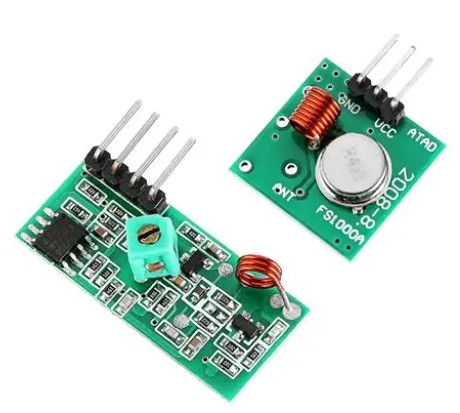
433MHZ RADIO FREQUENCY
Share :
The FS1000A refers to a highly popular and inexpensive pair of radio frequency (RF) modules: a Transmitter (TX) and a Receiver (RX). These modules are widely used in hobby electronics, DIY remote control, and simple short-range wireless data links.
Frequency and Modulation: The modules operate at the unlicensed 433 MHz Industrial, Scientific, and Medical (ISM) band. They use ASK (Amplitude Shift Keying) or OOK (On-Off Keying) modulation. This means data is transmitted simply by turning the radio carrier signal ON (for a '1' or HIGH) and OFF (for a '0' or LOW). This method is power-efficient and simple to implement but offers minimal security and is susceptible to interference.
The Transmitter (TX): This small board accepts a digital data stream (e.g., from an HT12E encoder or a microcontroller GPIO pin, like the ESP32). It requires only power and a single data input pin. The transmission range is typically limited to tens or a few hundred meters, depending on the antenna length and environment.
The Receiver (RX): This super-regenerative or super-heterodyne receiver continuously listens on the 433 MHz frequency. When it detects a signal, it outputs the reconstructed digital data stream on its data pin. Super-regenerative types are cheaper but offer lower selectivity and sensitivity compared to super-heterodyne types.
The FS1000A pair is an ideal choice for simple, one-way wireless applications where low data rates and short range are acceptable, such as:
Remote control toys.
Wireless alarms and doorbells.
Simple weather station data transmission.
Pairing with encoder/decoder ICs like the HT12E/HT12D for fixed code remote switching.