

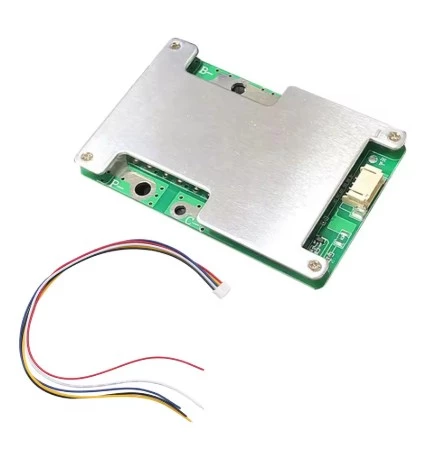
4S 100A LIFEPO4 BMS SYSTEM
Share :
A 4S 100A LiFePO4 BMS (Battery Management System) is a high-power protection circuit designed for a battery pack consisting of four Lithium Iron Phosphate (LiFePO4) cells connected in series.
This configuration is commonly used to create a nominal 12.8V battery pack, serving as a powerful, lightweight replacement for traditional 12V lead-acid batteries in various applications.
| Feature | Detail | Calculation/Meaning |
| Series (S) Count | 4S | 4 cells in series. |
| Chemistry | LiFePO4 | Lithium Iron Phosphate, known for safety and long cycle life. |
| Nominal Voltage | 12.8V | 4cells X 3.2V cell (Nominal) |
| Max Charge Voltage | 14.4V – 14.6V | 4cells X 3.65V cell (Max) |
| Continuous Current | 100A | Maximum continuous discharge current the BMS can safely handle. |
| Peak Current | 120A – 150A | Maximum current allowed for short bursts (e.g., starting a motor). |
| Cell Balancing | Yes | Includes passive balancing to equalize cell voltages (typically around 50mA). |
The 4S 100A BMS is crucial because it ensures the safety and longevity of the LiFePO4 cells. Its primary protection features include:
Overcharge Protection: Disconnects the charging source when any cell reaches its upper limit (typically 3.65V), preventing overheating and permanent damage.
Over-Discharge Protection: Disconnects the load when any cell drops below its minimum voltage (typically 2.5V), which prevents irreversible capacity loss.
Overcurrent Protection: Cuts off the circuit if the load attempts to draw more than the continuous or peak current limit (100A Peak 120A), protecting the cells and the BMS itself from overheating and fire.
Short-Circuit Protection: Instantaneously cuts off the current in the event of an external short circuit.
Temperature Protection: Uses an NTC (Negative Temperature Coefficient) sensor to monitor the battery temperature and will shut down if the pack gets too hot (or too cold).
High-Current Use Cases
The 100A rating makes this BMS ideal for applications with high power demands:
Solar/Home Backup: Powering approx. 1000W to approx. 1200W inverter (at 12V) for small off-grid cabins, RVs, or backup systems.
Electric Scooters/E-Bikes: Providing reliable, high-current power for propulsion.
Vehicle Applications: Replacing lead-acid batteries for car starting (though specific cold-cranking amps may vary) and powering marine applications like trolling motors.
Wiring Overview
Wiring a 4S BMS requires connecting the balance wires in the correct sequence, starting from the total negative (B- or B0) up to the total positive (B+ or B4).
B- Connection (Thick Wire): Connects to the total negative terminal of the entire battery pack.
P-/C- Connection (Thick Wire): This is the output terminal for the load (P-) and/or the input terminal for the charger (C-). Many BMS units have a "common port" (P- handles both charge/discharge) or a "separate port" (P- for discharge, C- for charge).
Balance Wires (Thin Wires): A multi-pin connector is used to connect to the positive terminal of each individual cell in the series, allowing the BMS to monitor and balance their voltage.16Incorrect wiring of balance leads will damage the BMS.