

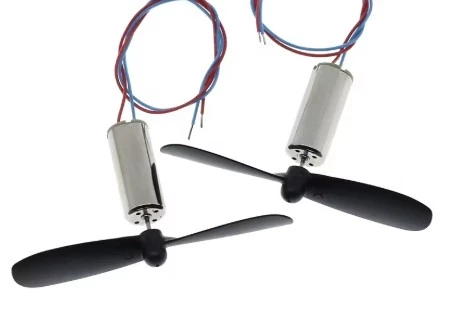
716 Coreless DC Motor 3.7- 4.2v
Share :
That specific motor description refers to a very common type of micro coreless DC motor typically used in small drone quads, miniature helicopters, and other lightweight DIY RC projects.
Here is a breakdown of what those specifications mean, particularly for performance and application:
| Specification | Meaning | Application Impact |
| DC 3.7V–4.2V | Operating Voltage Range | This motor is designed to run directly from a single-cell (1S) LiPo battery, which typically charges to 4.2V and discharges down to about 3.7V under load. |
| 716 | Physical Dimensions | This is the standard naming convention for these motors: 7mm is the diameter of the motor shell, and 16mm is the length of the motor shell. |
| Coreless | Motor Type | Instead of a heavy iron armature core, the winding is wrapped around itself. This results in: lighter weight, much higher RPM, extremely fast acceleration, and no cogging torque (smooth operation at low speeds). |
| Micro DIY Helicopter | Intended Use | Confirms its lightweight, high-RPM design is perfect for multi-rotor aerial applications where thrust and responsiveness are key. |
| Great Torque | Relative Performance | Relative to other micro motors (like 6mm motors), the larger 7mm diameter allows for longer windings, providing better torque for its size, enabling it to spin a propeller effectively. |
| High Speed Motor | Performance | Coreless motors typically operate in the 30,000 to 50,000 RPM range when unloaded, depending on the specific winding (KV rating). |
| With Propeller | Inclusion | Often, these motors come bundled with a small, press-fit propeller designed to maximize thrust at these high rotational speeds. |
Direct Drive: These motors are almost always used for direct drive—the propeller snaps directly onto the shaft without a gearbox—due to their high RPM and light weight.
Heat Management: While efficient, running coreless motors at high current for extended periods can cause them to overheat and reduce their lifespan. They are best suited for flight times of 5 to 10 minutes.
Current Draw: A 716 motor under load (spinning a propeller) can typically draw 0.5A to 2A, depending on the propeller size and the specific KV winding. You must use a suitable electronic speed controller (ESC) or MOSFET driver on your flight controller board that can