

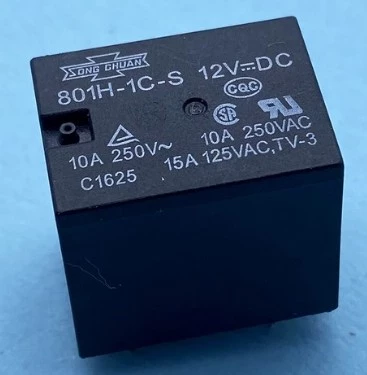
801H-1C-C 12VDC RELAY (USED)
Share :
The 801H-1C-C 12VDC is a high-power, miniature PCB-mount relay commonly used in automotive electronics, household appliances (like air conditioners and heaters), and industrial control systems.It is manufactured by companies like Song Chuan.
801H: The series designation. The "H" typically indicates a high-capacity version (handling higher amperage than the standard 801 series).
1C: Refers to the contact form. 1C means SPDT (Single Pole Double Throw), meaning it has one common terminal that switches between a Normally Closed (NC) and Normally Open (NO) contact.
C: This usually denotes the flux-tight or "wash tight" case type, protecting the internals during the soldering process.
12VDC: The nominal coil voltage required to trigger the relay.
The 801H-1C-C 12VDC is a high-power, miniature PCB-mount relay commonly used in automotive electronics, household appliances (like air conditioners and heaters), and industrial control systems.1It is manufactured by companies like Song Chuan.
801H: The series designation. The "H" typically indicates a high-capacity version (handling higher amperage than the standard 801 series).
1C: Refers to the contact form. 1C means SPDT (Single Pole Double Throw), meaning it has one common terminal that switches between a Normally Closed (NC) and Normally Open (NO) contact.3
C: This usually denotes the flux-tight or "wash tight" case type, protecting the internals during the soldering process.
12VDC: The nominal coil voltage required to trigger the relay.
Key Technical Specifications
| Feature | Specification |
| Contact Rating | 10A to 15A at 250VAC / 30VDC |
| Coil Voltage | 12V DC |
| Coil Power | Approx. 0.36W to 0.45W (Low power consumption) |
| Contact Material | Usually Silver Tin Oxide (AgSnO_2) for better arc resistance |
| Switching Life | 100,000 operations (Electrical) |
Terminal Layout (Bottom View)
This relay typically has 5 pins:
Coil Pins (2 pins): Located at one end. Applying 12V across these activates the electromagnet.
Common (COM): The center or main input pin.
Normally Closed (NC): Connected to COM when the relay is OFF.
Normally Open (NO): Connected to COM when the relay is ON.
In the context of the 24V or 12V inverters we've discussed, this relay is often used for:
AC Transfer Switch: Automatically switching a load between Grid power and Inverter power.
Soft-Start Bypass: Shorting out a current-limiting resistor once the high-voltage DC bus capacitors are charged.
Remote Turn-On: Using a low-power switch to engage the high-current DC stage of the inverter.
Protection Disconnect: Physically breaking the connection if the EGS002 board detects a critical fault.
Flyback Diode: When driving this relay from a transistor or microcontroller (like an Arduino or the EGS002 aux outputs), you must place a diode (e.g., 1N4007) in parallel with the coil (cathode to positive). This prevents the "inductive kick" from destroying your control circuit when the relay turns off.
Current Limits: While rated for 10A–15A, if you are switching inductive loads (like motors or large transformers), it is best to "derate" the relay and only run it at 5A–6A to prevent the contacts from welding together.