

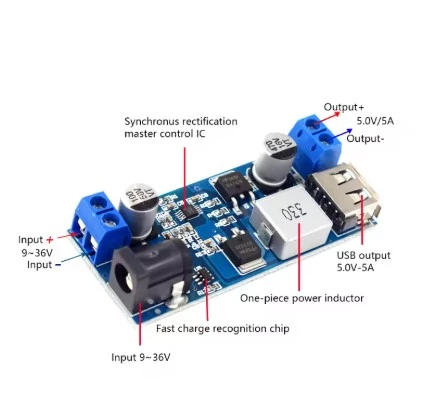
9-36V TO 5V@5A BUCK CONVERTER
Share :
This device is a highly practical and common type of switching power supply module. It's designed to efficiently convert a higher DC voltage down to a stable 5V output, often used for charging modern electronics.
Here are a breakdown of the specifications and the key features of this module:
DC-DC Step Down Buck Converter Module
1. Core Functionality (Buck Converter)
Input Range (V_IN): 9V, 12V or 24V (or any voltage within the typical supported range, usually up to 36V).
Output (V_OUT): Fixed 5V.
Step Down (Buck): It efficiently converts the higher input voltage to the lower 5V output.
2. Key Specifications
| Specification | Value | Significance |
| Output Current | 5A | This is a high current rating for a small module. It means it can power demanding devices or charge multiple devices simultaneously (e.g., 5A at 5V = 25W). |
| Efficiency | High | Because it is a switching (Buck) converter, its efficiency is generally 85% to 95%. This is much higher than a linear regulator (like the LM1117), meaning less energy is wasted as heat. |
| Replacement | "Replace LM2596S" | This indicates the module uses a more modern or powerful switching controller chip (like an MP1584, XL4015, or similar) that surpasses the capability of the older 3A capacity LM2596S regulator chip. |
| Output Type | Adjustable/USB | It often includes terminals for both standard wire connections and a dedicated USB-A port, making it immediately useful for charging phones or tablets. |
3. Application as a Phone Charging Module
Using this module for charging mobile devices is its primary function, but it requires a crucial feature:
DCP (Dedicated Charging Port) Protocols: Modern devices (phones, tablets) need to "read" specific voltage levels on the USB data pins (D+ and D-) to determine how much current they can safely draw.
A basic 5V supply will only allow a device to draw 0.5A.
To achieve the full 5A capacity (shared across ports) and enable fast charging (drawing 1A, 2A, or more), the module must include charging recognition chips (like a dedicated BC1.2 or Apple/Samsung protocol chip) to correctly signal the phone. If the module is advertised specifically for phones, it usually includes this signaling capability.
4. Advantage Over Linear Regulators (LM7805 or LM1117)
Consider converting 24V to 5V at a 2A load:
| Metric | Buck Converter (This Module) | Linear Regulator (e.g., 7805) |
| Power Dissipation (P_DISS) | Very Low (due to high efficiency) | High:(24V - 5V) \times 2A = 38W |
| Efficiency | approx 90% | 5V / 24V approx 21% |
| Conclusion | Cool and highly effective. | Requires a massive heat sink and is very wasteful. |