

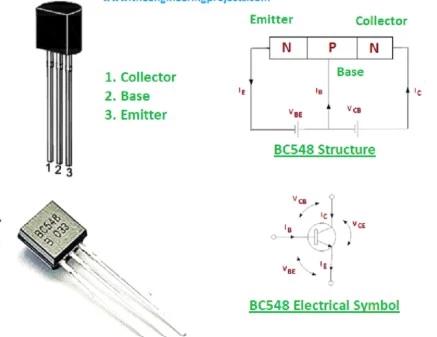
BC548 NPN
Share :
The BC548 is one of the most common and widely used general-purpose NPN bipolar junction transistors (BJT), often employed for small-signal amplification and switching.
💡 BC548 Product Detail
Core Function and Type
- Type: NPN Bipolar Junction Transistor (BJT).
- Function: Primarily used for switching (turning on/off) or amplification (increasing signal strength) in low to medium power applications.
- Operating Principle: Since it's an NPN transistor, current flows from the Collector to the Emitter when a small positive current is applied to the Base. It's commonly used for low side switching, where the load is connected to the positive supply and the transistor switches the load's return path to ground.
Key Specifications
Parameter | Typical Value | Description |
Collector Current (I_C) | 100mA | The maximum continuous current the transistor can switch or amplify. |
Collector-Emitter Voltage (V_CE) | 30V | The maximum voltage it can withstand between the Collector and Emitter. |
DC Current Gain (h_FE) | 110 to 800 | The ratio of Collector current to Base current (beta). This dictates the amplification factor. |
Power Dissipation (P_D) | 500mW | the maximum power it can safely dissipate at room temperature. |
Package and Pinout
- Package: The BC548 is most commonly found in the compact, plastic TO-92 through-hole package.
- Pinout: When viewed from the flat side, the standard European/Pro-Electron pinout is typically:
1. Collector
2. Base
3. Emitter
Common Applications
The BC548 is a workhorse in electronics for its high gain and low cost:
Audio and Sensor Amplification: Used extensively in the initial amplification stages for microphones, sensors, and other small signals.
Simple Switching: Ideal for driving small loads like $\text{LEDs}$ or very small relays, or for interfacing low-voltage microcontrollers with slightly higher-voltage circuits.
Hobbyist and Educational Projects: Its robustness and widespread availability make it a staple in prototyping and educational electronics kits.