

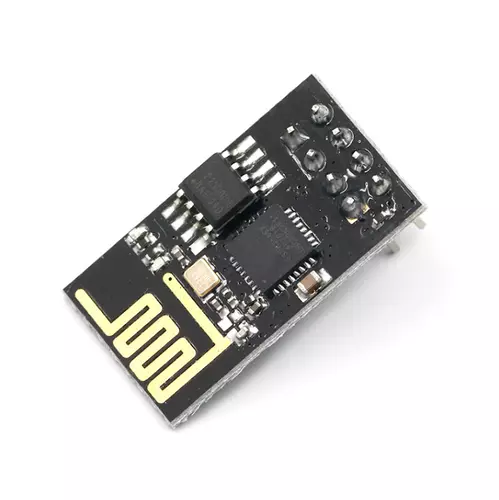
ESP8266 01S WIFI MODULE
Share :
The ESP8266 ESP-01S is a very popular, compact, and affordable Wi-Fi module based on the Espressif ESP8266 chip. It was one of the first and smallest boards to bring inexpensive Wi-Fi connectivity to microcontroller projects, making it a foundational component in the world of IoT.
| Feature | Detail |
| Chip | ESP8266EX |
| Connectivity | Wi-Fi802.11b/g/n |
| Processor | 32-bit Tensilica L106 Microcontroller |
| Flash Memory | Typically, 1MB (8Mbit) or 4MB |
| Operating Voltage | 3.3V DC |
| I/O Pins | 2 usable GPIO pins (GPIO0 and GPIO2) |
| Interface | UART (Serial) for communication and programming |
Unlike larger ESP boards (like the ESP-12E or ESP32), the ESP-01S is very minimal, exposing only a few key pins on its 2 X 4 double-row header:
| Pin Name | Function | Notes |
| VCC | Power Supply | Must be 3.3V. Applying 5V will damage the chip. |
| GND | Ground | Common Ground connection. |
| RX | Receive Data | Connects to your microcontroller's TX pin. |
| TX | Transmit Data | Connects to your microcontroller's RX pin. |
| CH_PD | Chip Power Down | Must be connected to VCC (3.3V) to enable the chip. |
| RST | Reset | Connect momentarily to GND to restart the chip. |
| GPIO0 | General Purpose I/O 0 | Used as a digital pin for control. Must be LOW to enter Flash/Programming Mode. |
| GPIO2 | General Purpose I/O 2 | Used as a digital pin for control. |
The ESP8266 is a 3.3V device. If you are communicating with a 5V microcontroller (like an Arduino Uno), you must use a level shifter on the TX and RX lines to prevent damaging the ESP-01S.
The ESP-01S can be programmed in two main ways:
AT Commands: Out of the box, it often comes pre-loaded with firmware that accepts text-based AT commands via the TX RX pins. This allows another microcontroller (like an Arduino) to use the ESP-01S as a simple Wi-Fi modem.
Arduino IDE/Micro Python: You can flash custom firmware directly to the chip using the Arduino IDE or Micro Python. This requires a separate USB-to-Serial (FTDI) adapter and specific wiring to force the chip into Flash Mode:
GPIO0 connected to GND
RST momentarily connected to GND
Due to its small size and minimal pin count, the ESP-01S is best suited for simple, compact applications like:
Smart Switches: Used in compact relays (as you saw in a previous question) or wall switches.
Simple Sensor Nodes: Sending a single sensor reading (e.g., temperature or humidity) to a cloud service.
Remote Control: Basic ON/OFF control of remote devices.