

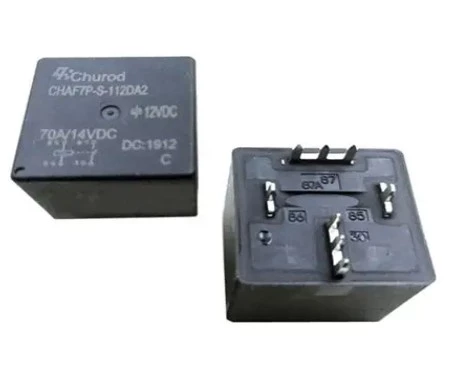
F7P-S-112DA2 70A 12VDC RELAY(USED)
Share :
The F7P-S-112DA2 12VDC (often manufactured by CHUROD) is a heavy-duty automotive "Mini" ISO relay. Unlike the previous PCB relays we discussed, this is a high-current powerhouse designed to handle the massive electrical loads found in cars, trucks, and high-power DC systems like your 12V/24V inverters.
F7P: The series designation for high-current automotive relays.
1A: Contact form — SPST-NO (Single Pole Single Throw, Normally Open). It has only two power pins: Open when off, Closed when on.
H: High-capacity version, rated for 70A.
12VDC: The nominal coil voltage.
Key Technical Specifications
The standout feature of this relay is its ability to handle continuous high DC current without melting its housing or welding its contacts.
| Feature | Specification |
| Max Switching Current | 70A (Continuous) / 150A (Inrush) |
| Contact Material | Silver Tin Oxide (AgSnO_2) |
| Coil Resistance | Approx. 80Omega to 90Omega (Draws about 140mA @ 12V) |
| Terminals | 4-Pin total (2 small for coil, 2 extra-wide for power) |
| Temperature Range | -40°C to +125°C |
Because this relay handles 70A, the pins are not equal in size. Using standard small connectors on the power pins will result in fire or melted wires.
Pins 85 & 86 (Small): The Coil terminals (12V control signal).
Pins 30 & 87 (Large/Wide): The High-Current Load terminals. These are usually 9.5mm wide blades to accommodate heavy-duty female spade connectors or soldering to thick busbars.
This relay is specifically suited for the DC side of your inverter projects where current is highest:
Main Battery Disconnect: For your 12VDC to 220VAC 400W or higher systems, this relay can act as the "Main Power Switch." It allows you to use a tiny, low-current toggle switch on your dashboard to turn on the massive 70A+ flow from the battery.
Dual Battery Isolator: If you are running an inverter in a vehicle, this relay can connect the "house" battery to the "starter" battery only when the engine is running, preventing you from being stranded with a dead engine battery.
High-Current Charger Control: In your EE55 30A Charger setup, this relay provides a physical safety break between the charger and the battery bank.
Critical Safety Warning: Heat and Wiring
At 70 Amperes, even a slightly loose connection will generate enough heat to melt plastic.
Wire Gauge: You must use at least 4AWG or 6AWG copper wire for the power terminals (30 and 87).
Crimping: Use a professional hydraulic crimper for the terminals. "Pliers-style" crimping will fail under 70A of continuous load.
Flyback Protection: Always use a diode (like a 1N4007) across pins 85 and 86 to protect your control electronics from voltage spikes when the relay turns off.