

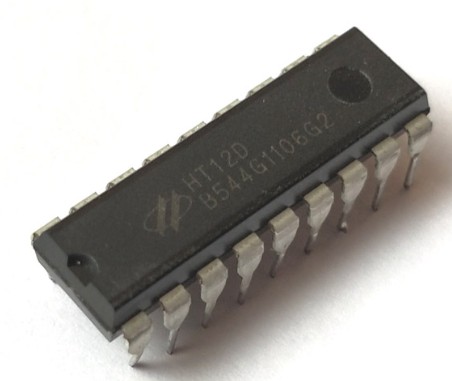
HT12D DECODER
Share :
The HT12D is a 2^12 Series Decoder integrated circuit, commonly manufactured by Holtek, used primarily in basic Radio Frequency (RF) and Infrared (IR) remote control applications. It works by interpreting a serial stream of data transmitted by its paired encoder chip, the HT12E.
Decoding Principle: The chip receives a 12-bit address/data stream (sent in a sequence of pulses) and verifies its authenticity. This 12-bit structure is divided into two main parts:
8 Address Bits (A0-A7): These pins must match the address set on the transmitting HT12E encoder. This serves as a security handshake, ensuring the decoder only responds to the correct remote.
4 Data Bits (D8-D11): These pins contain the actual command information (e.g., turning a relay ON, opening a gate, etc.).
Valid Transmission (VT) Output: The most crucial output pin is VT (Valid Transmission). This pin goes HIGH only when the chip successfully receives the entire 12-bit address and data stream and confirms the 8 address bits match its local setting. This signal is often used to latch the output data or trigger a microcontroller interrupt.
Low Power and Simplicity: The HT12D is highly valued for its simplicity, requiring minimal external components (only a pull-down resistor on the input and an external oscillator resistor, typically 51 k Omega, for timing). It directly outputs the decoded 4-bit command, making it easy to interface with basic switching circuits or microcontrollers.
The HT12D is ideal for non-critical, single-channel or multi-channel remote control tasks such as garage door openers, light switches, simple alarms, and car alarm systems where range is moderate and security requirements are minimal.