

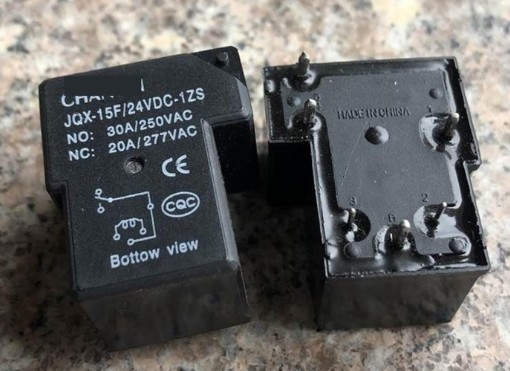
JQX-15F (T90) 24VDC RELAY
Share :
The JQX-15F, widely known as the T90 relay, is the slightly smaller but extremely popular sibling to the T91. It is the "gold standard" for power switching on PCBs, especially in appliances and power electronics like your 24V inverter system.
While the T91 (JQX-30F) is often used for 40A loads, the T90 is typically optimized for 30A switching in a more compact footprint.
| Feature | Specification |
| Contact Rating | 30A at 240VAC / 28VDC |
| Coil Voltage | 24V DC (Nominal) |
| Coil Power | Approx. 0.9W |
| Contact Form | 1C (SPDT), 1A (SPST-NO), or 1B (SPST-NC) |
| Dielectric Strength | 1,500V AC (between open contacts) / 2,500V AC (coil to contact) |
| Mounting | PCB terminals with optional "top-side" Quick Connects |
Since you are designing a 24V inverter (using the EE55 2kW transformer), using a 24V relay is much more efficient than a 12V one:
Direct Connection: You can power the relay coil directly from your 24V battery bank (usually via a small transistor) without needing a voltage regulator or buck converter to drop it to 12V.
Lower Current Draw: A 24V coil requires half the current of a 12V coil to achieve the same magnetic force, which reduces heat in your control circuitry.
The T90 is the ideal "bridge" between the control logic and the high-power AC output.
You can use this relay to connect the AC output to the load only after the EGS002 has completed its "Soft Start" and confirmed the sine wave is stable. This prevents "surges" from hitting your appliances during startup.
In your EE55 30A Charger project, the T90 can handle the 30A charging current perfectly. Use it as a safety disconnect to prevent the battery from discharging back into the charger when the AC mains are off.
By using the 1C (SPDT) version, you can create a basic Uninterruptible Power Supply (UPS).
NC Contact: Connect to Grid Power.
NO Contact: Connect to Inverter Output.
Common: Connect to the Load.
When 24V power is lost or a fault occurs, the relay "drops back" to Grid power automatically.
The "T-Shape" Footprint: The T90 has a very specific pin layout. The two coil pins are at one end, while the heavy-duty power pins are spread out at the other to prevent high-voltage arcing on the PCB.
PCB Trace Reinforcement: Switching 30A through a green PCB is dangerous. Even with "heavy copper" boards, you should strip the solder mask off the high-current traces and flow a thick layer of solder (or solder a copper bus wire) over the trace to increase its current-carrying capacity.
Flyback Protection: Since this is a 24V coil, the "kickback" voltage when the relay turns off can be over 200V. You must use a diode (1N4007) across the coil pins to protect your 24V control transistors.