

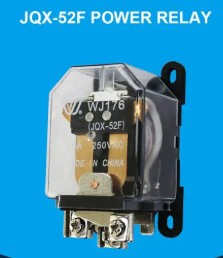
JQX-52F 40A 12VDC RELAY(USED)
Share :
The JQX-52F 12VDC is a heavy-duty Power Relay (often referred to as a "Contactor-style" relay) designed for high-capacity industrial and automotive applications.Unlike the previous PCB-mount relays, the JQX-52F is physically much larger and typically features screw terminals or lug connectors to handle the high current securely.
Key Technical Specifications
| Feature | Specification |
| Contact Rating | 40A at 250VAC / 28VDC |
| Max Switching Power | 10,000 VA (AC) / 1,120 W (DC) |
| Coil Voltage | 12V DC |
| Contact Form | Available as 2Z (DPDT) or 1Z (SPDT) |
| Mechanical Life | 10,000,000 operations |
| Mounting Style | Bolt-down flange with screw terminals |
Most 40A relays are designed to be soldered into a circuit board. The JQX-52F is designed for panel mounting.
Industrial Ruggedness: The casing is usually made of high-temperature flame-retardant material. It is built to withstand the vibration and heat found in machine control cabinets.
Screw Terminals: Because switching 40A through a PCB is difficult and risky, this relay allows you to bolt heavy-gauge wires (up to 8AWG) directly to the relay. This eliminates the "burnt PCB" syndrome common in high-power projects.
DPDT (2Z) Option: Many JQX-52F models come in a "2Z" configuration, meaning it has two independent sets of 40A contacts. This allows you to switch both the Live and Neutral lines of a 220V AC system simultaneously for maximum safety.
Given the high-power components you've mentioned (EE55 transformers and 30A chargers), the JQX-52F is an excellent choice for the "final stage" of your build:
For a 2000W Pure Sine Wave Inverter, the JQX-52F is the perfect safety gate. Because it can switch 40A, it handles the full load with plenty of headroom, preventing the contacts from overheating during long periods of use.
In an Off-Grid system, you can use the DPDT version to switch your entire home circuit between Grid Power and Inverter Power. Since it switches both poles (L and N), it ensures there is no "ground loop" or back-feeding into the utility lines.
If your inverter is running on a 12V system, a 40A rating limits you to about 500W. However, in a 24V system, this relay can safely manage a 1000W DC load.
Installation & Wiring
Coil Terminals: These are usually the smaller screw terminals (Pins 7 and 8). Apply 12V here to engage the relay.
Contact Terminals: These are the large, heavy-duty screws. Always use ring terminals (lugs) on your wires to ensure a solid, low-resistance connection. A loose screw at 40A will act like a heater and melt the relay.
Snubber Diode: As with all your other relays, remember to add a 1N4007 diode across the coil terminals to prevent back-EMF from damaging your control electronics.