

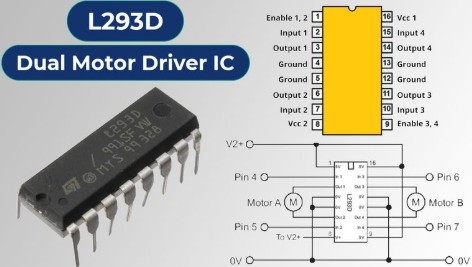
L293D MOTOR DRIVER
Share :
The L293D is a monolithic integrated circuit (IC) designed to function as a motor driver. It provides a simple, robust solution for interfacing low-current, low-voltage control signals from microcontrollers (like the ESP32) with the higher current and voltage requirements of DC motors, stepper motors, and solenoids.
H-Bridge Configuration: The L293D contains four independent half-H driver circuits. These are typically paired to form two full H-bridge circuits. An H-bridge allows current to flow in both directions through a load (like a DC motor), enabling both forward and reverse rotation.
Driving Capability: The chip can drive two independent DC motors bi-directionally, or one stepper motor. Each channel can typically handle a continuous output current of up to 600 mA (0.6 Amps) at voltages ranging from 4.5V up to 36V.
Separate Power Supplies: The L293D requires two separate voltage inputs:
V_SS (Logic Supply): Powers the internal control logic (typically 5V, supplied by the microcontroller).
V_S (Motor Supply): Powers the motors themselves (up to 36V), keeping the motor power separate from the sensitive logic power.
Built-in Diodes ("D" Variant): The "D" suffix indicates that the chip includes internal flyback (or suppression) diodes. These diodes are crucial for protecting the driver IC from high-voltage spikes generated by the motor's inductance when the power is switched off.
Application
The L293D is an essential component in robotics and automation projects, commonly used for controlling the movement of wheels (differential drive systems), linear actuators, and various mechanisms in remote-controlled devices.