

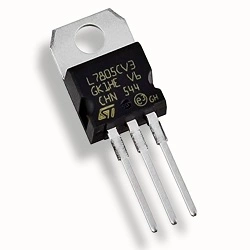
LM7805
Share :
The LM7805 is a ubiquitous and popular three-terminal positive linear voltage regulator integrated circuit (IC). Its primary function is to accept a higher, unregulated input DC voltage and provide a stable, fixed +5 volt DC output voltage.
The LM7805 is part of the 78xx series of regulators, where the '78' indicates it's a positive voltage regulator, and the '05' specifies the 5-volt output.
Key Features and Specifications
Fixed Output Voltage:+5 Volts.
Input Voltage Range: Typically 7V to 25V (some datasheets specify up to 35V max), but it must always be greater than the output voltage (plus a dropout voltage of about 2V to function correctly).
Maximum Output Current: Can typically supply up to 1A to 1.5A depending on the package and heat sinking.
Internal Protection: It includes built-in protection features like thermal overload protection and short-circuit current limiting.
Ease of Use: It requires very few external components, typically just input and output capacitors for stability and noise filtering.
Pinout (TO-220 Package)
The standard LM7805 (often in a TO-220 package) has three pins:
| Pin No. | Pin Name | Description |
| 1 | Input (V_IN) | Connects to the unregulated input DC voltage (e.g., 9V or 12V). |
| 2 | Ground (GND) | Common ground connection for both input and output. |
| 3 | Output (V_OUT) | Provides the regulated +5V DC output. |
Applications and Considerations
Common Use: Powering digital logic circuits (like TTL or 5V microcontrollers like Arduino) that require a stable 5V supply.
Linear Regulator Efficiency: As a linear regulator, it dissipates the excess voltage as heat. The power dissipated is calculated as P_D = (V_IN - V_OUT) \ I_OUT. For higher input voltages or larger output currents, a heat sink is essential to prevent the IC from overheating and engaging its thermal shutdown protection.