

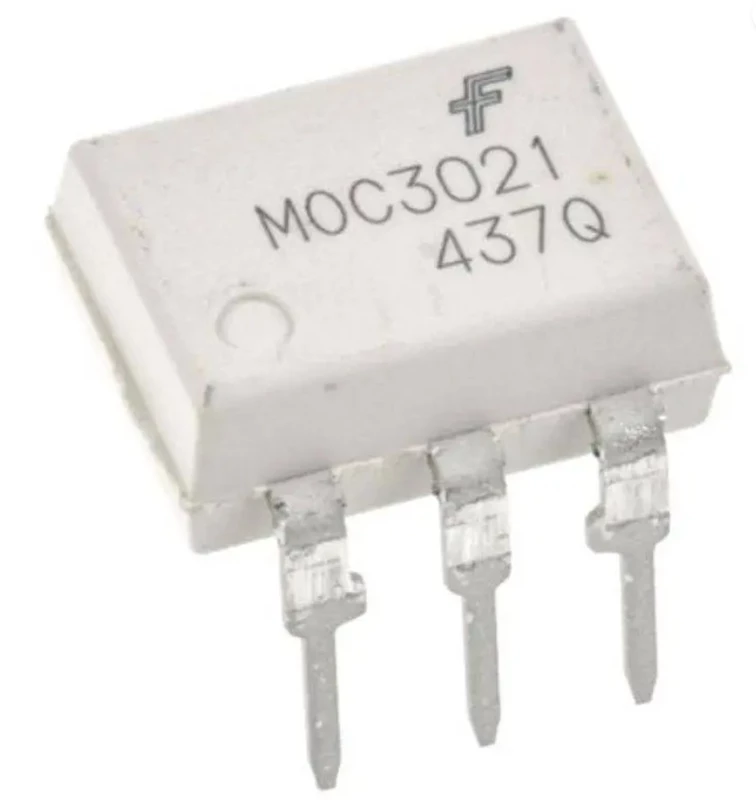
MOC3021 OPTOCOUPLER
Share :
The MOC3021 optocoupler is a popular 6-pin integrated circuit designed as a random-phase TRIAC driver optoisolator. Its primary function is to provide safe, high-voltage electrical isolation between a low-voltage control circuit (like a microcontroller) and a high-voltage AC load circuit.
Key Features and Specifications
| Feature | Specification/Description |
| Function | Optically Isolated TRIAC Driver |
| Input | Gallium Arsenide Infrared Emitting Diode (LED) |
| Output | Light-activated Silicon Bilateral Switch (Phototriac) |
| Peak Blocking Voltage (V_DRM) | 400V (Suitable for 220 VAC lines) |
| Isolation Voltage | High Isolation (Typically 5300V_rms minimum) |
| Trigger Current (I_FT) | Maximum 15mA (Input current required to turn on the output) |
| Zero-Crossing | Non-Zero-Crossing (or Random-Phase) |
| Package | 6-Pin Dual In-Line Package (DIP) |
Pin Configuration
The device is split into two electrically isolated sections: the input (control) side and the output (AC switching) side.
| Pin Number | Pin Name | Description |
| 1 | Anode | Anode of the internal IR LED (Input Control) |
| 2 | Cathode | Cathode of the internal IR LED (Input Ground) |
| 3 | N.C. | No Connection (Used for isolation and physical support) |
| 4 | Main Terminal 2 (MT2) | One terminal of the internal Phototriac (Output) |
| 5 | N.C. | No Connection (Used for isolation and physical support) |
| 6 | Main Terminal 1 (MT1) | The other terminal of the internal Phototriac (Output) |
Function and Applications
1. Isolation and Control
The MOC3021 allows a low-voltage DC signal to control a high-voltage AC circuit. When a current (above the I_FT threshold) flows through the input LED (Pin 1 to Pin 2), the emitted infrared light triggers the internal phototriac between Pins 4 and 6. This internal phototriac then acts as a gate to trigger a larger, external power TRIAC that handles the high-current load.
2. Non-Zero-Crossing (Random-Phase)
The MOC3021 is a random-phase optocoupler, meaning its output TRIAC driver will turn ON immediately when the input LED is activated, regardless of where the AC voltage waveform is in its cycle.
Benefit: This feature is necessary for phase-control applications (like dimmers) where the turn-on time relative to the AC zero-crossing point must be precisely controlled by the microcontroller to regulate the power delivered to the load.
Contrast: A zero-crossing optocoupler (like the MOC3041) only turns on when the AC voltage is near zero, which is ideal for simple ON/OFF switching to minimize electromagnetic interference (EMI) and component stress.
Common Applications:
AC Light Dimmers and solid-state relays (SSRs) for phase-control.
Motor and Fan Speed Controllers (using phase-control).
Static AC Power Switching (used as a driver for a larger power TRIAC).
Interfacing microcontrollers (MCUs) to 115V, 220VAC peripherals.