

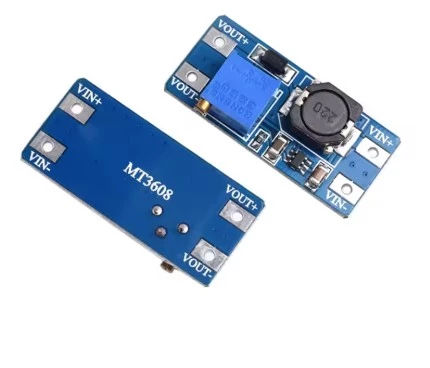
MT3608 DC-DC Step-Up (Boost) Converter Module
Share :
The MT3608 is a compact and highly efficient DC-DC Step-Up (Boost) Converter Module commonly used in electronics projects to increase a lower input voltage to a higher, regulated output voltage.
It's a popular choice for battery-powered projects because it can squeeze higher voltages out of low-voltage sources like single Li-ion cells or two AA batteries.
| Parameter | Value | Notes |
| Input Voltage (V_IN) | 2V to 24V DC | The range of voltage you supply to the module. |
| Output Voltage (V_OUT) | Adjustable from 5V to 28V DC | The output voltage must always be higher than the input voltage. |
| Maximum Output Current | 2A Peak | While the chip has a 4A switch current limit, the module's continuous output current is typically limited to 1A to 1.5A to prevent overheating, especially if the voltage difference is large. |
| Efficiency | Up to 93% (some sources suggest 97%) | High efficiency is maintained by using Pulse Frequency Modulation (PFM) at light loads. |
| Switching Frequency | 1.2MHz | This high frequency allows the use of small, low-cost inductors and capacitors. |
The module features four solder points and a multi-turn trimmer potentiometer:
| Pin Name | Connection | Function |
| IN+ | Positive wire from your power source (e.g., battery). | Input Voltage Positive (V_IN) |
| IN- | Negative wire from your power source (Ground). | Input Voltage Negative (GND) |
| OUT+ | Positive wire to your load (the device you are powering). | Boosted Output Voltage Positive (V_OUT) |
| OUT- | Negative wire to your load (Ground). | Output Voltage Negative (GND) |
Connect Input: Connect your power source (e.g., a 3.7V Li-ion battery) to IN+ and IN-.
Adjust Voltage (Crucial Step):Before connecting your final device to the output, connect a multimeter to OUT+ and OUT-.
Rotate Potentiometer: Use a small screwdriver to turn the trim pot (the small screw) on the board.
You may need to turn the screw 20 or more turns counterclockwise initially to get the output voltage into its adjustable range, as they sometimes ship with the potentiometer set to minimum (output equal to input).
Adjust the screw until the multimeter reads the desired output voltage (e.g., 5V or 12V).
Connect Load: Once the output voltage is stable and correct, disconnect the multimeter and connect your final load.
Battery-Powered Projects: Powering 5V Arduino/ESP boards or 12V peripherals (like LED strips or motors) from a 3.7V single Li-ion battery.
Portable Devices: Creating custom power banks or upgrading voltage for portable electronics.
LED Drivers: Providing a higher, regulated voltage to drive LED lighting systems.
Robotics: Ensuring stable voltage for microcontrollers, sensors, and low-power motors in mobile robots.