

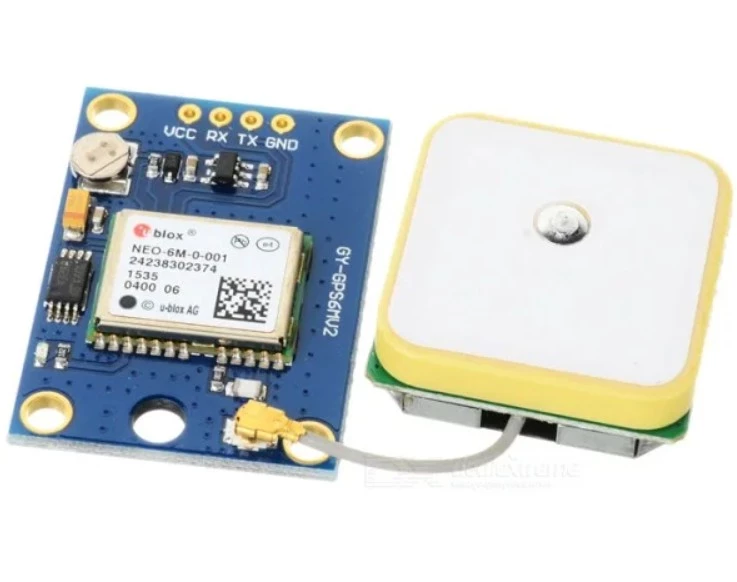
NEO-6M GPS MODULE
Share :
The NEO-6M GPS module is a popular and cost-effective standalone Global Positioning System (GPS) receiver. It is built around the u-blox NEO-6M chip and is widely used by hobbyists and engineers for applications that require location, velocity, and time information.
Key Features and Specifications
GPS Chip: u-blox NEO-6M
Interface: UART (Universal Asynchronous Receiver/Transmitter) is the primary interface.
Default Baud Rate:9600 bps (configurable up to 115200bps).
Operating Voltage: Typically 2.7V to 3.6V (3.3V recommended). Breakout boards often include a voltage regulator, allowing them to be powered by 5V (like from an Arduino).
Positioning Accuracy: Approximately 2.5meters (CEP).
Antenna: Usually comes with a ceramic patch antenna and a UFL connector for an optional external active antenna.
Memory: Includes an onboard EEPROM and a rechargeable backup battery (or supercapacitor) to store configuration settings and aid in faster "Hot Start" time.
Update Rate: Default is 1HZ, configurable up to 5 Hz.
Pin Configuration (Common Breakout Board)
The module typically exposes four main pins for basic use:
| Pin Name | Description | Connection |
| VCC | Power Supply Input (3.3V or 5V depending on the board) | Connect to the microcontroller's 5V or 3.3V supply. |
| GND | Ground | Connect to the microcontroller's GND. |
| TX | Transmit Data (Data OUT) | Connect to the microcontroller's RX pin. |
| RX | Receive Data (Data IN) | Connect to the microcontroller's TX pin. |
How It Works and Data Output
Principle: The module receives signals from a constellation of GPS satellites and uses a mathematical process called trilateration to calculate its 3D position, velocity, and precise time. It requires a clear view of the sky and a lock on at least four satellites for a full 3D fix.
LED Indicator: The small LED on the module indicates the status of the satellite fix:
Off/Solid: Searching for satellites.
Blinking (approx. 1Hz): A valid GPS position fix has been achieved.
Data Format: The module transmits data via the TX pin using serial communication in the form of standard NMEA sentences (National Marine Electronics Association). These sentences are strings of raw data containing information like latitude, longitude, altitude, and time. A common library like TinyGPS++ is often used with microcontrollers (like Arduino) to parse these raw strings into readable values.