

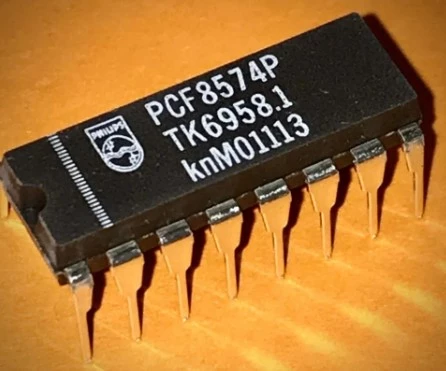
PC8574P I2C CHIP
Share :
The PC8574P I2C chip is an 8-bit quasi-bidirectional I/O expander for the two-line I²C bus. The part number you listed, PC8574P, specifically refers to the PDIP (Plastic Dual In-line Package) version of the PCF8574 (or sometimes PCA8574) series of I/O expander integrated circuits, with 'P' designating the package type.
I/O Expansion: It provides 8 additional digital input/output pins (P0–P7) to a microcontroller using only the two I²C pins (SDA and SCL). This is useful for microcontrollers with a limited number of GPIO pins
I²C Interface: It communicates via the I²C protocol (also known as TWI).
The PCF8574 has a fixed 4-bit address (0x20 to 0x27 in 7-bit addressing) where the last three bits are set by the A0, A1, and A2 hardware address pins.
The similar PCF8574A (or PCA8574A) has a different fixed 4-bit address (0x38 to 0x3F) which allows up to 16 total devices (8x PCF8574 and 8x PCF8574A) on the same I²C bus.
Quasi-Bidirectional I/O: The 8 I/O pins can be used as either inputs or outputs without the need for a separate data-direction control register.
For output, the pins act as a strong current sink (up to 25 mA), which is excellent for directly driving LEDs (connected between the power supply and the pin).
For input, the pin is set to a high state where it has a weak internal pull-up to V_CC (around 100mA). An external device can then pull the pin low to read a logic low.
Interrupt Output (overline INT): It has an active-low open-drain interrupt output pin that can be connected to a microcontroller's interrupt pin. This signal goes low when one of the input pins changes states, allowing the microcontroller to avoid continuously polling the device.
LED Driving: Directly controlling multiple LEDs (e.g., in displays or signs).
Keypads/Button Monitoring: Easily reading the state of a large number of buttons or a matrix keypad.
System Control: Remote control of general-purpose digital logic, such as relays or small motors.
LCD Modules: Many popular I²C LCD adapters use a PCF8574 or similar I/O expander.
You can learn how to interface one of these expanders with an Arduino by watching PCF8574 I2C LCD | Connecting an LCD Display to Arduino using I2C Adapter. This video shows how the PCF8574 chip is used on a module to interface an LCD display with an Arduino.