

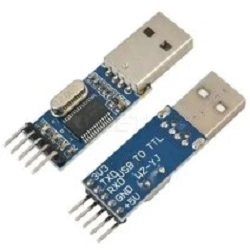
PL2303 USB TO TTL
Share :
The PL2303 USB to TTL is a common USB-to-Serial converter module that acts as a bridge to allow a computer (which typically uses USB) to communicate with devices that use Transistor-Transistor Logic (TTL) serial communication (also known as UART).
It is named after the PL2303 chip from Prolific Technology, which performs the conversion.
Primary Function and Use
The main purpose of the PL2303 module is to provide a simple way to establish a serial connection between your PC and a microcontroller or other serial device.
PC Side: Connects to a standard USB port.
Device Side: Provides TTL-level (usually 3.3V or 5V) serial lines.
Common Applications:
Microcontroller Programming/Debugging: Uploading code to development boards or using a PC terminal program to send and receive serial data from a microcontroller (like Arduino, ESP32, or STM32).
Firmware Upgrades: Flashing new firmware onto devices like network routers, GPS modules, or satellite receivers that have a serial debug port.
Serial Communication: Interfacing a PC with any serial device, such as a Bluetooth module (HC-05/06) to configure it using AT commands.
Pinout and Connection
The module typically has the following pins, which are connected to the corresponding pins on the target device:
| Pin Name | Description | Connection to Target Device |
| VCC / 5V | Power supply output (optional) | Connect to the target device's VCC (only if powering it from the USB) |
| GND | Ground (0V reference) | Connect to the target device's GND |
| TXD (Transmit Data) | Data output from the PC/module | Connect to the target device's RXD (Receive) pin |
| RXD (Receive Data) | Data input to the PC/module | Connect to the target device's TXD (Transmit) pin |
| 3.3V | Low voltage power output (optional) | Connect to the target device's VCC if it's a 3.3V device |
Crucial Note: For data transfer, the Transmitter (TXD) of one device must always connect to the Receiver (RXD) of the other, and vice-versa.
Drivers and Compatibility
The PL2303 chip requires a Virtual COM Port (VCP) driver to be installed on the PC. This driver allows the USB connection to be recognized by the operating system as a traditional serial COM port
Driver Issues: Older or counterfeit versions of the PL2303 chip (like the PL-2303HXA or PL-2303X) often have compatibility issues with newer Windows operating systems (Windows 8, 10, 11), resulting in a "Code 10" error in Device Manager.
Solution: Using the newest chip versions (like PL2303HXD or PL2303GC) or installing specific, compatible drivers (often older versions or third-party modifications) is often required to resolve these issues.