

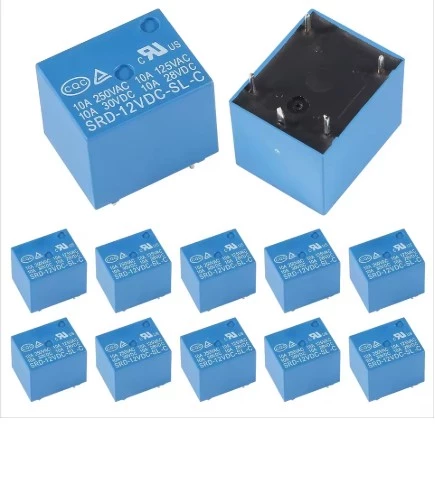
QUALITY 10A RELAY
Share :
The SRD relay is an extremely common, subminiature, electromechanical power relay often used in DIY electronics (like Arduino and Raspberry Pi projects) and various consumer appliances.
It is primarily manufactured by companies like Songle, and its full model number indicates its specific specifications, the most common being the SRD-12VDC-SL-C.
The core specifications that apply to most variants of the SRD series are:
| Parameter | Detail | Description |
| Coil Voltage | 3V, 5V, 6V, 9V, 12V, 24V, 48V DC | The voltage required to energize the internal electromagnet and switch the contacts. The 5V and 12V versions are the most common in hobby electronics. |
| Contact Form | 1 Form C (SPDT) | Single Pole Double Throw. This means it has one Common (COM) pin that can be switched to either a Normally Open (NO) or Normally Closed (NC) pin. |
| Max Switching Current | 10A | The maximum current the contacts can safely switch (often derated for safety). |
| Max Switching Voltage | 250V AC or 30V DC | The maximum voltage the contacts can handle. This allows it to switch common household line voltage (120V AC or 240V AC). |
| Mounting | PCB (Through-Hole) | Designed to be soldered directly onto a Printed Circuit Board. |
| Size | Small (approx 19mm} X 15.5 X 15mm) | Designed for high-density mounting. |
The Model Code Breakdown:
The full model code, e.g., SRD-05VDC-SL-C, is interpreted as:
SRD: Model of the relay.
05VDC: Nominal coil voltage is 5 Volts DC.
S: Structure (usually Sealed type for better protection).
L: Coil sensitivity (often indicates 0.36W or 0.45W power consumption).
C: Contact form (1 Form C / SPDT).
The SRD relay is used as an electrically operated switch to allow a low-power control circuit (like a microcontroller) to switch a high-power load (like a motor, light, or appliance).
In most hobby projects, you see the SRD relay integrated into a Relay Module, which includes:
The SRD relay itself.
A flyback diode (to protect the microcontroller/transistor from the coil's back EMF).
A transistor (to allow the microcontroller's low-current signal to drive the higher current relay coil).
Often an LED (to indicate when the relay is active).