

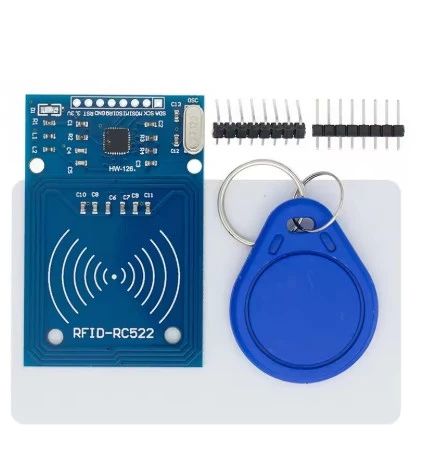
RC522 RFID READER
Share :
The RC522 is a widely used, low-cost integrated circuit (IC) reader/writer module for 3.56MHz Radio-Frequency Identification (RFID) technology. It's extremely popular in hobbyist and prototyping projects (like with Arduino and Raspberry Pi) due to its affordability and the robust functionality of the Mifare protocol it supports.
| Feature | Detail |
| Operating Frequency | 13.56MHz (High Frequency - HF) |
| Supported Protocol | ISO/IEC 14443 Type A |
| Supported Tags | Primarily Mifare Classic 1K and 4K cards and tags (which use the 14443A standard). |
| Communication | SPI (Serial Peripheral Interface) is the main communication protocol used between the module and the microcontroller. |
| Operating Voltage | 3.3V DC (Crucial: The IC is 3.3V native, though some modules accept 5V for power, the logic pins remain 3.3V). |
| Read Range | Typically, 2cm to 5cm, depending on the antenna and tag size. |
The RC522 module typically has 8 pins, but only 7 are usually connected for SPI communication with a microcontroller:
| RC522 Pin | Function | Arduino/ESP32 Connection |
| VCC | Power Supply | 3.3V (or 5V on some modules) |
| RST | Reset | Any Digital Pin (e.g., D9) |
| GND | Ground | GND |
| IRQ | Interrupt | (Optional, usually left unconnected) |
| MISO | Master In Slave Out (Data from RC522) | MISO Pin (e.g., D12 on Uno) |
| MOSI | Master Out Slave In (Data to RC522) | MOSI Pin (e.g., D11 on Uno) |
| SCK | Serial Clock | SCK Pin (e.g., D13 on Uno) |
| SDA (SS) | Slave Select / Chip Select | Any Digital Pin (e.g., D10) |
Important $3.3\text{V}$ Logic Note: If you are using a 5V board like an Arduino Uno, you must either power the RC522 from the 3.3V pin and be aware of the voltage difference on the logic lines or use level shifters to protect the RC522's MISO and MOSI pins.
The RC522 module is commonly used for:
Access Control: Reading the Unique ID (UID) of a card to grant or deny entry (e.g., a smart lock or gate control).
Inventory Tracking: Tagging items with Mifare} tags and scanning them for inventory management.
Payment/Ticketing Simulation: Mimicking simple transaction or ticketing systems.
Data Storage: The Mifare Classic tags allow for storing and retrieving small amounts of data across different sectors, enabling secure data exchange.