

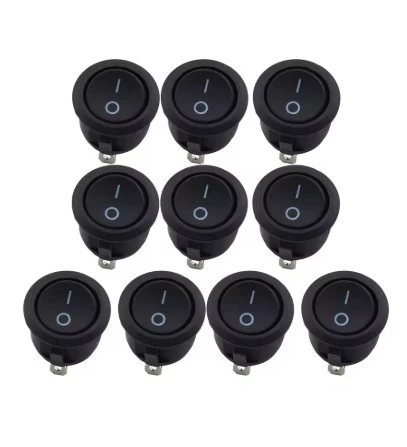
ROUND SPST 3A/6A SWITCH
Share :
That describes a very common, simple, and affordable type of electrical switch often used in small appliances, power strips, and low-power devices.
Here is a detailed breakdown of the specifications for the ON-Off 2 Pin Round Snap Rocker Boat Switch:
1. Physical Characteristics
Round: Indicates the outer bezel or mounting diameter is circular.
Snap Rocker:
Rocker: The switch uses a pivoted lever (a "rocker") that is pressed down on one side (ON) and then the other (OFF).
Snap: It is designed to "snap" into a panel cutout without screws, held in place by friction or small retaining clips built into the housing. This makes installation very easy.
2 Pin: This is a SPST (Single Pole, Single Throw) switch. It has only two terminals, meaning it simply acts as an open or closed connection for a single circuit (like a simple light switch).
The switch has two sets of ratings based on the voltage type:
| Rating | Voltage Type | Maximum Current (Amperes) |
| AC 250V | High Voltage AC (e.g., European mains) | 3A |
| AC 125V | Low Voltage AC (e.g., North American mains) | 6A |
Interpretation:
If used on a 250V AC circuit (like in many parts of Africa, Asia, or Europe), the current drawn by your device must NOT exceed 3 Amps.
If used on a 125V AC circuit (like in North America or Japan), the current drawn by your device must NOT exceed 6 Amps.
It is a basic rule that when the voltage is higher, the current rating of the switch contacts must be lowered to prevent excessive heat and arcing.
This type of switch is suitable for simple ON/OFF control of:
Low-power appliances (fans, desk lamps, small electronics).
DIY projects and power supply enclosures.
Automotive or marine DC applications (though the AC rating is provided, these switches often handle DC, but usually at a slightly lower, derated current capacity).
Wiring: Since it only has two pins, you simply wire one side of the circuit (the hot/live line) to one pin, and the other side of the hot/live line (going to the load) to the other pin. It interrupts the flow of electricity when set to the "OFF" position.