

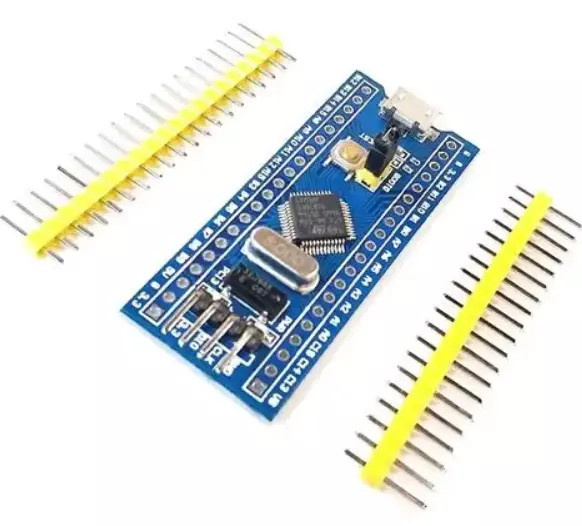
Stm32f030c8t6 DEVELOPMENT BOARD
Share :
The STM32F030C8T6 Development Board, often sold as a compact "Minimum System" core board, is a low-cost, high-value platform for embedded development based on the STMicroelectronics STM32F030C8T6 microcontroller.
This MCU is part of the STM32 Value-line and features the energy-efficient ARM Cortex-M0 core. It is a popular choice for budget-conscious projects like consumer electronics and simple IoT devices.
STM32F030C8T6 Key Specifications
The MCU on the board has the following core features:
| Feature | Specification | Description |
| Microcontroller | STM32F030C8T6 | Part of the STM32F0 Value-line series. |
| Core | ARM Cortex-M0 (32-bit RISC) | Focuses on power efficiency and cost-effectiveness. |
| Max Frequency | 48MHz | A solid clock speed for its class. |
| Flash Memory | 64KB | Program storage. |
| SRAM | 8KB | Volatile data storage (RAM). |
| I/O Pins | 39 (out of 48 pins on the LQFP package) | General Purpose Input/Output pins. |
| Peripherals | ADC (12-bit), Timers, PWM, RTC. | Rich set of peripherals for its low cost. |
| Communication | I2C, SPI, USART (up to 6) | Multiple serial communication options. |
| Package | LQFP-48 (T6 suffix) | Low-profile Quad Flat Package, surface-mounted. |
Common Development Board Features
The development boards (often small breakout modules) built around the STM32F030C8T6 typically include the following components to make the MCU usable:
Power and Clock
Micro USB Port: Used for power supply (typically 5V) and sometimes for serial communication (UART) via an on-board bridge chip.
External Power Headers: Additional pins to supply the required 3.3V and ground.
External Crystals: Usually includes both an 8MHz (or 4MHz to 32MHz) main oscillator for high-speed clocking and a 32.768kHz low-speed oscillator for the Real-Time Clock (RTC).
Programming and Debugging
SWD (Serial Wire Debug) Header: A small header (usually 4 or 6-pin) that provides access to the SWCLK and SWDIO pins. This is essential for flashing firmware and debugging the chip using an external programmer like the ST-LINK/V2 or J-Link.
Boot Jumpers/Buttons: Pins or buttons (often labelled BOOT0 and BOOT) used to select the boot mode:
Boot from Flash: Normal operation (runs your loaded program).
Boot from System Memory (Bootloader): Allows programming via a UART serial port (using tools like the STM32 Flash Loader Demonstrator).
User Interface
Reset Button: Hardware button to restart the MCU.
User LED: A simple LED connected to a GPIO pin for initial testing (e.g., blinking program).
Pin Headers: All or most of the 39 GPIO pins are typically broken out to standard 2.54 mm (0.1inch) male headers, making it easy to connect to breadboards or prototype circuits.
Development Environment
Programming the STM32F030C8T6 board is commonly done using:
STM32CubeIDE: STMicroelectronics' official, free IDE (Integrated Development Environment) based on Eclipse, which includes the CubeMX graphical configuration tool.
Keil MDK-ARM or IAR Embedded Workbench: Commercial IDEs widely used in professional development.16
PlatformIO/Arduino IDE: With the appropriate STM32 core installed, the board can often be programmed using the Arduino framework, providing a simpler, more familiar environment for hobbyists.