

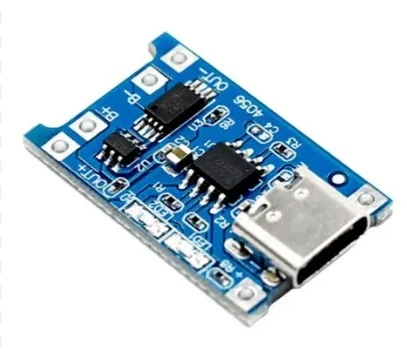
TP4056 CHARGER MODULE
Share :
That's an excellent choice for a charging module The TP4056 is one of the most popular and simple linear charge management controllers for single-cell lithium-ion batteries.
🔋 TP4056 Module Product Detail
The TP4056 module is a complete, standalone, constant-current/constant-voltage (CC/CV) linear charger that uses the TP4056 chip to safely charge single-cell lithium-ion (Li-ion) or lithium-polymer (Li-Po) batteries.
Key Features and Specifications
Chip: TP4056 (or sometimes TC4056CN3722clones).
Charging Method:CC/CV (Constant-Current, Constant-Voltage). This is the standard, safe charging profile for lithium batteries.
Input Voltage (Source): Typically, 4.5V to 5.5VDC. Most modules include a Micro-USB or USB-C port for easy 5V input.
Charge Voltage (Battery End): Fixed at 4.2V. This is the standard full charge voltage for a single Li-ion cell.
Maximum Charge Current: Up to 1000mA(1A), which is typically set by an external resistor.
Charging Status Indicators:
RED LED (or D1): Indicates the battery is currently Charging.
BLUE/GREEN LED (or D2): Indicates the charge is Complete or Trickle charging is active.
Important Module Functions
Current Regulation: The charge current is set by a small resistor on the board, labeled RPROG.
The standard 1Omega resistor provides approx 1000mA.
Changing this resistor allows you to safely charge smaller batteries (e.g.,10Omega sets the current to approx 130mA).
Thermal Protection: The TP4056 chip includes internal thermal feedback circuitry to regulate the charge current and limit the die temperature during high-power or high-ambient-temperature operation.
Automatic Termination: The chip automatically terminates the charge cycle when the battery voltage reaches the 4.2V regulation voltage and the charge current drops below 1/10th of the programmed current (C10 termination).
Reverse Battery Protection: The basic TP4056 chip does not have built-in reverse polarity protection for the battery pins (BAT+ and BAT). Connecting the battery backward can damage the module and potentially the battery.
The Common DW01 Protection Circuit
Many modules sold (especially the ones with four integrated circuits and pads for battery protection) include a DW01 protection chip and two MOSFETs (like 8205A) to offer:
Over-discharge Protection: Prevents the battery voltage from dropping below about 2.4V.
Over-current/Short-circuit Protection: Shuts off the output if the load draws excessive current or if the output is shorted.
Over-charge Protection: Acts as a secondary safeguard, preventing the battery voltage from exceeding approx 4.3V.