

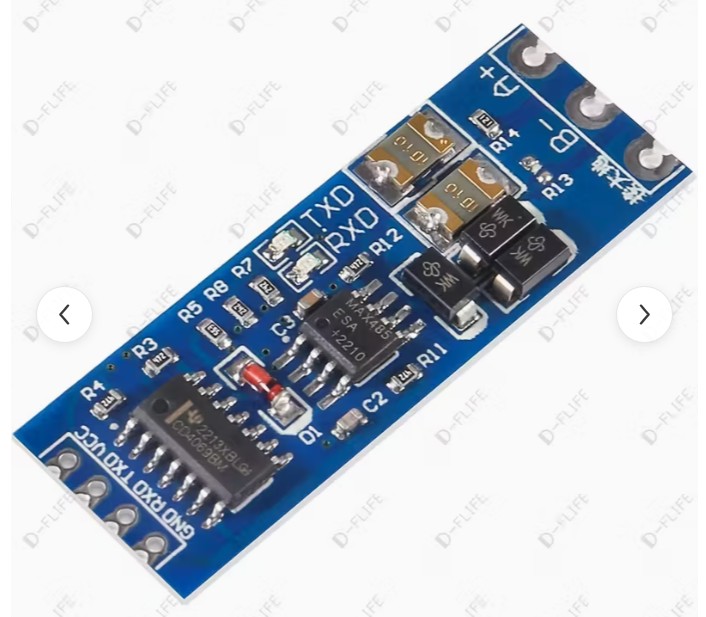


TTL TO RS485/RS422 MODULE
Share :
A TTL (Transistor-Transistor Logic) to RS485/RS422 converter module is a basic, vital interface circuit used to adapt the low-voltage, single-ended signaling of microcontrollers (usually 3.3V or 5V TTL/CMOS logic) for transmission over rugged, industrial-grade RS485 or RS422 networks.
TTL Input/Output: This interface connects directly to the UART pins (TX/RX) of a microcontroller (like Arduino, Raspberry Pi, or dsPIC). The data here is simple, low-power, and referenced to ground.
Differential Transceivers: The primary component is a specialized integrated circuit (such as a MAX485 or similar) that performs the critical electrical conversion:
RS485/RS422: The chip converts the single-ended TTL signal into a differential signal—two wires (A/B or Y/Z) that transmit the same data but with opposite polarity. This differential technique provides superior noise immunity and enables much longer transmission distances (up to 1200 meters).
RS422 is a point-to-multipoint standard using four wires (separate twisted pairs for transmission and reception), allowing full-duplex communication.
RS485 is a multi-point standard typically using two wires, allowing half-duplex communication on a bus structure.
Direction Control (RE/DE): For RS485 half-duplex communication, the module requires a control pin (often labeled DE/RE) to switch the transceiver between Driver Enable (DE), where the module actively drives data onto the bus (TX), and Receiver Enable (RE), where it listens for incoming data (RX).
These modules are essential for industrial communication, allowing microcontrollers to reliably transmit data across noisy environments and over long cable runs to devices like security cameras, temperature sensors, motor controllers, and other networked equipment.