

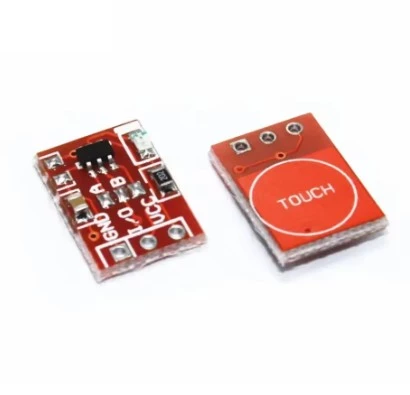
TTP223 TOUCH SENSE
Share :
The TTP223 is a small, low-cost integrated circuit (IC) designed specifically to implement a single-channel capacitive touch switch. It's the most common chip found on simple touch sensor modules used with microcontrollers like Arduino.
The TTP223 module replaces a traditional mechanical button with a solid-state, non-moving surface that detects touch based on changes in capacitance.
Capacitance Sensing: The circuit continuously monitors the capacitance of the sensor pad (the metal area on the module).
Detection: When a human finger approaches the pad, it acts as a conductor and increases the capacitance relative to the module's ground.
Output Change: When this change exceeds a predefined threshold, the TTP223 chip registers a "touch" and changes the state of its Output Pin (OUT) from LOW to HIGH (or HIGH to LOW, depending on its configuration).
| Feature | Detail |
| Type | Capacitive Touch Sensor |
| Chip | TTP223 |
| Operating Voltage | 2V to 5.5V DC (Compatible with 3.3V and 5V logic) |
| Output Current | approx. 8mA at 3V |
| Interface | Simple digital output (High or Low) |
| Response Time | Fast (typically < 60ms in low-power mode, faster in normal mode) |
| Power Consumption | Very low, especially in low-power mode. |
The TTP223 module typically has two tiny solder jumpers, usually labeled A (or A/B) and B (A/B or T/D), which allow you to configure its behavior without code:
This determines the default state of the output pin when the sensor is not touched.
| Jumper A State | Output Logic | Behavior |
| Open (Default) | Active HIGH | Output is LOW when idle, goes HIGH when touched. |
| Closed (Soldered) | Active LOW | Output is HIGH when idle, goes LOW when touched. |
This determines how the output behaves when a touch is detected.
| Jumper B State | Output Mode | Behavior |
| Open (Default) | Direct/Momentary | Output is HIGH/LOW only while held. Acts like a mechanical pushbutton. |
| Closed (Soldered) | Toggle/Latch | Output changes state (toggles) with each new touch. Acts like a latching switch. |
The module typically has three main pins for connection:
| Pin Name | Connection | Function |
| VCC | Power supply (usually 5V or 3.3V) | Power for the chip. |
| GND | Ground | Circuit ground. |
| OUT | Digital Input on Microcontroller | The signal pin; connects to an Arduino input pin. |
The TTP223 is an excellent component for replacing mechanical switches in projects where you need a sleek, non-moving interface, such as smart mirrors, hidden switches, or robotics control panels.