

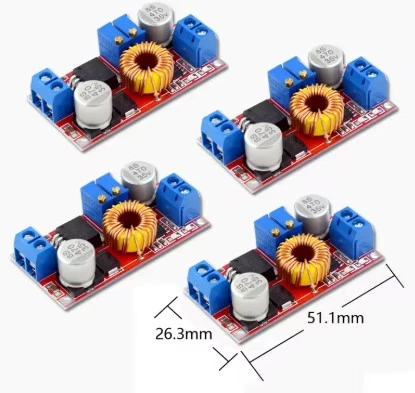
XL4015 DC-DC Step-Down (Buck) Converter Module
Share :
The XL4015 is a highly popular and widely used DC-DC Step-Down (Buck) Converter Module. Its primary function is to efficiently reduce a higher input DC voltage to a lower, regulated output DC voltage.
It's known for its high-power handling capability and adjustable output voltage, making it suitable for charging batteries and powering various electronics from a higher voltage source.
| Parameter | Value | Notes |
| Type | Step-Down (Buck) Converter | The output voltage (V_OUT) must always be lower than the input voltage (V_IN). |
| Input Voltage (V_IN) | 8V to 36V DC | Must be at least 1.5V higher than the desired output voltage. |
| Output Voltage (V_OUT) | Adjustable from 1.25V to 32V | Regulated via an onboard multi-turn potentiometer. |
| Maximum Output Current | 5A | The module's rated current. Continuous current should be kept around 3A to 4A unless adequate cooling is provided. |
| Efficiency | Up to 96% | Very high efficiency is maintained by using synchronous rectification. |
| Switching Frequency | 180kHz | the frequency at which the internal switch operates. |
The module is simple to connect, often featuring four main solder points and one or more potentiometers.
IN+: Connects to the positive terminal of your higher voltage power source.
IN-: Connects to the negative terminal (Ground).
OUT+: Connects to the positive side of your load (the device you are powering).
OUT-: Connects to the negative side of your load.
Do not connect your final load yet.
Connect your input source (V_IN) to IN+ and IN-.
Connect a multimeter to OUT+ and OUT-.
Use a small screwdriver to turn the Voltage Potentiometer (often marked CV for Constant Voltage).
Adjust the screw until the multimeter reads the desired lower output voltage (e.g.,5V or 12V).
Many XL4015 modules have two potentiometers:
CV (Constant Voltage): Sets the final output voltage (as described above).
CC (Constant Current): Sets the maximum current limit. This is essential for charging batteries (like Li-ion or Lead-Acid), as you can set a safe charging current and voltage cut-off.
Battery Charging: Creating custom chargers for Li-ion, LiFePO4, or lead-acid batteries by setting a safe current limit (CC) and a charging cutoff voltage (CV).
Vehicle Power: Stepping down the 12V or 24V vehicle battery voltage to a steady 5V for USB charging or microcontrollers.
Bench Power Supply: Used as the voltage regulation stage in simple, adjustable lab power supplies.
LED Drivers: Providing a stable current and voltage for high-power LED arrays.